August 29, 2026
Pocket Travel Zoom Cameras: 24x Zoom That Fits
A travel zoom gives you 550mm of reach in a jacket pocket. Five used models worth buying, what separates them, and the checks that matter before you pay.
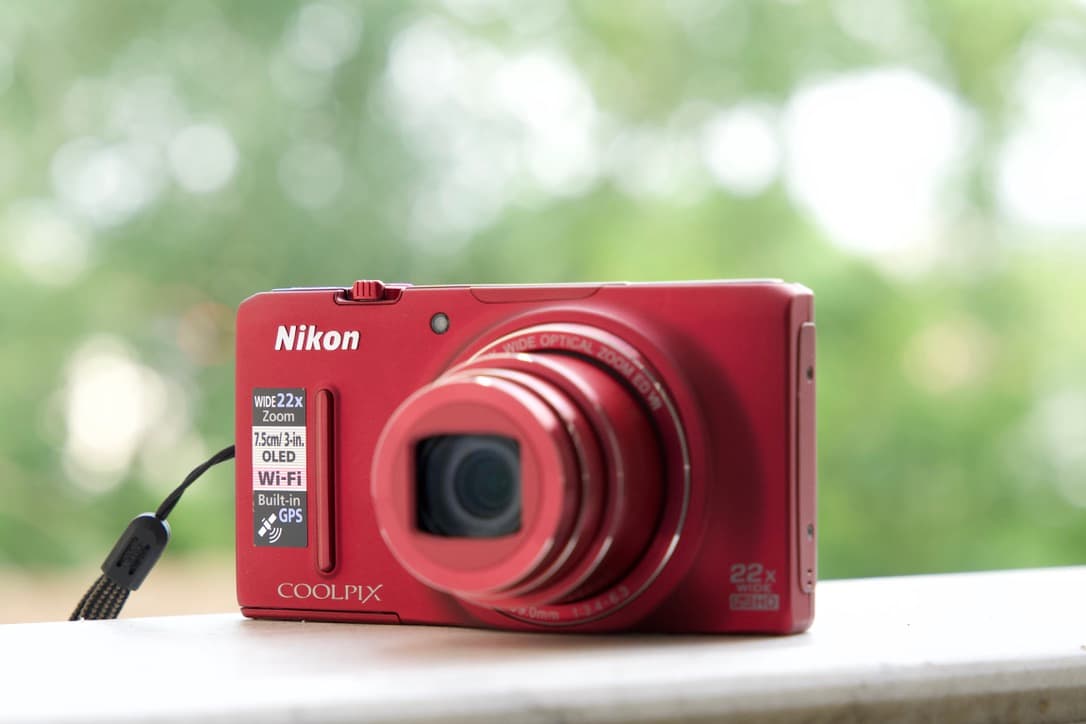
A travel zoom is the answer to a specific problem: you want real telephoto reach, and you are not willing to carry a bag. These cameras fit in a jacket pocket and still get you to 550 or 600mm, which is enough for a building across a square, a face in a crowd, or a detail on a mountainside.
They were the most competitive category in cameras between roughly 2011 and 2014, right before phones took the compact market apart. That competition is why the used ones are good, and why they are now cheap.
Nikon Coolpix S9500 — The Best of the Group
22x zoom covering 25mm to 550mm, an 18-megapixel backside-illuminated CMOS sensor, and a 3-inch OLED screen with 614,000 dots. OLED is the detail that matters here. Almost every rival used a standard LCD, and the difference in contrast and visibility outdoors is immediately obvious when you hold them side by side.
It also has built-in Wi-Fi and GPS. The Wi-Fi lets you move pictures to a phone without a cable, which is the single feature that makes a camera of this age still practical to use daily. GPS tags every frame with where you took it — genuinely useful on a trip you will want to retrace later.
If you want one recommendation from this list, this is it.
Sony Cyber-shot HX10V — The Low-Light Pick
16x zoom running 24mm to 384mm, built on an 18.2-megapixel Exmor R sensor. Exmor R is Sony's backside-illuminated design and it was the best small sensor of its generation — noticeably cleaner at high ISO than what Canon and Nikon were putting in comparable bodies.
Less reach than the Nikon, but a wider starting point at 24mm, which matters more than people expect for interiors and street work. It records 1080/60i video and has GPS. Buy this one if you shoot indoors and at night more than you shoot distant subjects.
Casio Exilim EX-H50 — The Reach Champion
24x zoom covering 25mm to 600mm from a 16-megapixel sensor, with sensor-shift stabilisation, in a genuinely slim body. This is the longest reach in the group, and Casio achieved it without making the camera notably thicker than its rivals.
Casio was never taken seriously as a camera brand, which is exactly why an EX-H50 costs less than a Nikon or Sony with similar specifications. The camera is better than the badge suggests. Its shorter-zoom sibling, the EX-H30, gives you the same slim body with less telephoto and a lower price.
Canon PowerShot SX160 IS — The AA-Powered One
16x zoom covering 28mm to 448mm, 16 megapixels, DIGIC 4 processing, and — the reason it is on this list — two AA batteries.
It is the thickest camera here and the only one that will not slide into a shirt pocket. In exchange you never worry about a proprietary battery that no longer holds charge, and you can walk into any shop anywhere and be shooting again in a minute. For long trips away from reliable power, that is worth more than a few millimetres of thickness. Canon's colour rendering is the friendliest of the four, too.
How to Choose Between Them
Do not choose on megapixels — they are all between 16 and 18, and on sensors this small the difference is noise, not detail.
Choose on the thing that will actually shape your day. Want the best screen and wireless transfer to your phone? The S9500. Shoot mostly in low light? The HX10V. Want maximum reach in the slimmest body? The EX-H50. Travelling somewhere you cannot count on charging? The SX160 IS.
What to Check When Buying Used
A travel zoom packs a long lens into a thin body, which means the zoom mechanism is under more strain than in any other type of camera. Extend it fully and retract it six or seven times. It must run smoothly and never display a Lens Error message. This is the fault that kills these cameras, and it is not economical to repair on every model.
Test the stabiliser at full zoom. Frame something distant at 550 or 600mm and half-press the shutter. The image should visibly settle. Without working stabilisation, a camera at this focal length is useless handheld.
Check the screen carefully against a bright background for dead pixels and pressure marks. On the S9500 specifically, look at the OLED for burn-in or uneven brightness, which is an OLED-specific failure that LCDs do not have.
On the GPS models, turn the feature on outdoors and give it a few minutes to acquire a lock. GPS chips of this era were slow, so be patient — but they should eventually work.
Open the battery door and inspect the contacts for white or green corrosion, and on the SX160 IS check both AA contacts carefully, since leaking cells are the usual killer of AA-powered bodies.
Finally, confirm the camera accepts and writes to a memory card. Some bodies of this generation cap out at 32GB SDHC and will not read modern high-capacity cards, so take a matching card with you.
Stock changes often, so check the shop for which of these are available right now; every one Silver Cam lists is tested at both ends of the zoom first. We check zoom travel, stabiliser function, screen condition and battery contacts on every body, and we service stuck zoom lenses on compacts like these. We also buy travel zooms you no longer use.